

A fully managed end-of-tenancy turnaround for a typical UK rental property costs somewhere between £300 and £1,500+, depending on property size, condition, and scope. That figure covers inspection and photographic reporting, clearance and compliant waste removal, deep cleaning throughout, carpet and window cleaning, and a final photographic handover. Optional neutral redecoration sits on top of that range.
This article is written for landlords, letting agents, and property managers who commission and pay for these services. It is not about tenant-facing deposit cleans.
Pro Tip: Before accepting any quote, insist on a written, itemised figure issued after an on-site inspection. Ballpark estimates issued remotely almost always change once a contractor sees the property.
- Inspection and photographic condition report
- Clearance and compliant waste removal
- Full deep clean (kitchen, bathrooms, throughout)
- Carpet and window cleaning
- Optional neutral redecoration
- Final photographic handover
Key takeaways
A fully managed end-of-tenancy turnaround for a typical UK rental property costs £300–£1,500+ depending on size, condition, and scope, and the most reliable way to control that cost is a written, itemised fixed quote issued after an on-site inspection.
| Point | Details |
|---|---|
| Budget by property size | Studio to 1-bed: £300–£1,500+; 2-bed: £300–£1,500+; 3-bed+: £300–£1,500+; HMO: £300–£1,500+ |
| Demand a fixed written quote | Insist on an itemised quote after on-site inspection; remote estimates almost always change |
| Require compliance documents | Waste transfer note, public liability insurance, and photographic handover are non-negotiable |
| Watch for stacked charges | VAT, contractor mark-ups, and add-on fees can push an 18% headline rate to over 21% effective cost |
| Use Ready to Rent | Fixed written quotes, five-working-day SLA, and a single point of contact for Merseyside turnarounds |
Table of Contents
- What does end-of-tenancy cleaning cost, line by line?
- How suppliers charge and the hidden costs that inflate your bill
- What should you budget by property size?
- How long does a managed turnaround take?
- How to get a fixed, reliable quote
- Which compliance documents should you require before paying?
- How to reduce turnaround costs without cutting standards
- Tax and accounting treatment for turnaround costs
- Ready to Rent: fixed quotes for Merseyside landlords
- A practitioner's view on where turnaround costs really go wrong
- Sources
- FAQ
What does end-of-tenancy cleaning cost, line by line?
The headline figure only makes sense when you know what is driving it. A managed turnaround is not a single service; it is a stack of coordinated tasks, each with its own cost logic.
| Line item | Typical pricing basis | Notes |
|---|---|---|
| Inspection and photographic report | Per visit | Establishes scope; essential before any fixed quote |
| Clearance and waste removal | Per load or per item | Regulated; requires a waste transfer note |
| Deep clean (kitchen, bathrooms, whole property) | Per job or per hour | Labour-intensive; largest single cost driver |
| Carpet cleaning | Per room or per m² | Condition-dependent; often quoted separately |
| Window cleaning (internal and external) | Per property or per pane | Frequently omitted from cheap quotes |
| Minor repairs | Per item | Snagging, silicone, door furniture |
| Neutral redecoration (optional) | Per room or per property | Materials plus labour; priced after inspection |
| Final photographic handover | Included or per visit | Documents completion for landlord and agent |
| Project management / single point of contact | Included or day rate | Coordination across trades; often undervalued |
Labour is the largest cost component in almost every turnaround. Materials (cleaning products, paint, filler) are secondary. Waste disposal is the third variable and the one most often under-quoted, particularly where a previous tenant has left significant volume. VAT is charged on top where the supplier is VAT-registered.

How suppliers charge and the hidden costs that inflate your bill
Fixed quotes versus itemised versus percentage models
Most reputable turnaround contractors issue a fixed per-job quote after an on-site inspection. That is the model to prefer: you know the total before work begins, and the risk of scope creep sits with the contractor rather than you.
Itemised time-and-materials quotes are common among smaller operators. They offer transparency but transfer cost risk to the landlord if the job takes longer than estimated.
Percentage or monthly management models appear where a letting agent bundles turnaround services into a management contract. Buy-to-let management costs typically run 10–15% of monthly rent plus VAT; for premium agents and HMOs the rate can reach 15–18%.
Hidden and stacked charges
A quoted headline rate rarely tells the whole story. Published schedules show that once lettings layers, management layers, monthly compliance add-ons and VAT are included, an advertised 18% can become an effective 21.3%. The same stacking applies to turnaround services embedded in management contracts.
Common charges that inflate the headline:
- VAT (20%) where the supplier is VAT-registered
- Contractor introduction mark-ups of 10–25% on third-party labour
- Urgent or out-of-hours surcharges
- Waste disposal fees quoted separately from clearance labour
- Inventory and check-in/out fees, commonly £100–£300 per event
- Monthly compliance or administration add-ons
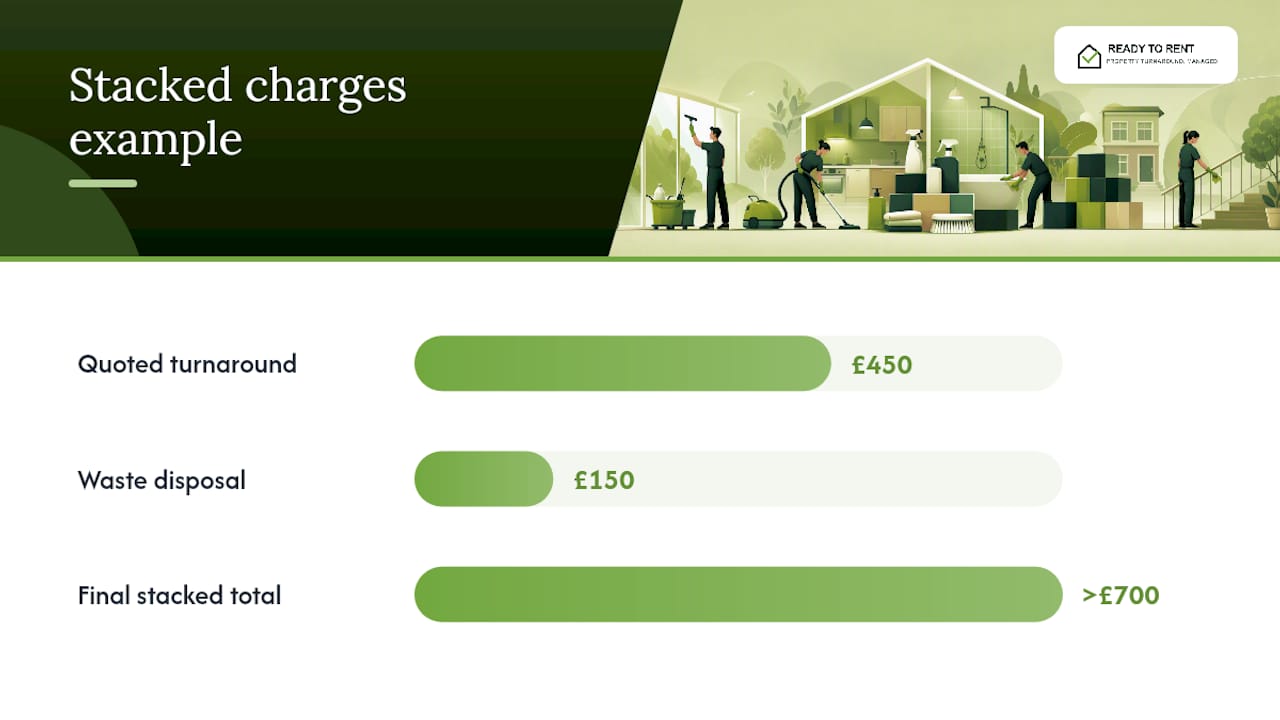
Stacking in practice: a turnaround quoted at £450 with a 15% contractor mark-up, a £150 waste disposal charge added separately, and VAT on top can land at over £700 before any redecoration. Always request an all-in, itemised figure.
Pro Tip: Ask every supplier to separate labour, materials, disposal, and VAT on the invoice. If they resist, that is a signal worth noting.
What should you budget by property size?
The figures below are illustrative ranges to frame procurement conversations. A fixed quote requires an on-site inspection; condition, age of stock, level of waste, urgency, and location all move the final number.
Principal drivers of variation:
- Condition on exit: heavy soiling, mould, or damage adds labour hours directly
- Waste volume: a furnished property left with contents can double clearance costs
- Urgency: weekend or next-day mobilisation carries a premium
- Location: Merseyside and the North West tend to price below London and the South East
- Age of stock: older properties with more surfaces, cornicing, or dated kitchens take longer
Letting and management charges commonly run 8–15% of rent or a fixed fee of around £50–£200 per month; placement, renewal, and inventory charges typically add several hundred pounds a year on top of that headline rate, so void-period turnaround costs are rarely the only relet expense to budget for.
How long does a managed turnaround take?
A standard agreed scope typically completes within five working days from initial inspection to final photographic handover. That timeline maps roughly as follows:
- Day 1: On-site inspection; photographic condition report produced; scope confirmed
- Day 2: Clearance and waste removal; waste transfer note issued
- Days 2–3: Deep clean throughout; carpets and windows
- Days 3–4: Minor repairs; redecoration where included
- Day 5: Final photographic handover; project sign-off
Accelerated timelines are possible but carry a cost. Weekend labour, emergency mobilisation, and after-hours working all attract surcharges. The Renters' Rights Act (effective May 2026) removed fixed-term renewal events in England, which increases the frequency of periodic tenancy relets and therefore the regularity with which turnaround costs arise.
Pro Tip: Include measurable SLA items in any contract: a named completion date, photographic handover as a condition of final payment, and a requirement for the waste transfer note before sign-off.
How to get a fixed, reliable quote
A reliable quote starts with the information you give the supplier, not just what you ask for.
- Share the tenancy history: move-in date, tenancy length, number of occupants
- Provide the existing photographic condition report if one exists
- Confirm access windows and any known hazards (asbestos, damp, pest issues)
- State the required standard: re-let ready, or full neutral redecoration
- Specify whether clearance is required and the approximate volume of contents
From the supplier, demand:
- A written, itemised fixed quote issued after an on-site inspection
- Confirmation of waste transfer note provision
- Public liability insurance certificate and references
- A clear payment schedule with inclusions and exclusions listed
- Named SLA: completion date and photographic handover
Sample quote request (email structure):
Which compliance documents should you require before paying?
Paying a contractor without the right paperwork is a risk on multiple fronts: legal, financial, and practical. Require all of the following before instructing work and before releasing final payment.
- Public liability insurance: protects you if damage occurs during the turnaround
- Waste transfer note: legally required under the Environmental Protection Act 1990 where controlled waste is removed; your proof of compliant disposal
- Written fixed quotation: issued after inspection; your protection against scope-creep invoices
- Photographic handover report: documents the property condition at completion; essential for dispute resolution
- SLA with remedies: names the completion date and what happens if it is missed
- Itemised invoice: separates labour, materials, disposal, and VAT for accounting purposes
Pro Tip: *Where a letting agent charges maintenance through the management account, ask for the original contractor invoice alongside the agent's invoice.
How to reduce turnaround costs without cutting standards
Negotiation levers worth using:
- Multi-property discount: if you have a portfolio, ask for a schedule-of-rates agreement rather than one-off pricing
- Fixed fee over percentage: on higher-rent properties, a fixed monthly or per-job fee almost always beats a percentage model
- Separate tenant-find from turnaround: bundled services rarely give you the best price on either component
- Cap maintenance mark-ups in writing: agree a maximum percentage above contractor invoice before signing any management contract
- Schedule re-let windows in advance: a contractor who can plan ahead prices more keenly than one called in at 48 hours' notice
Operational levers:
- Group small jobs across nearby properties to reduce mobilisation costs
- Use a pre-agreed contractor list to avoid emergency call-out rates
- Amortise inventory and check-in costs across the full tenancy cycle rather than treating them as one-off surprises
Several practical levers reduce cost: negotiating multi-property discounts, preferring fixed fees on higher-rent properties, separating tenant-find from full management, and demanding itemised invoices to eliminate opaque maintenance margins.
Pro Tip: Ask for a written commitment on void minimisation: a contractor who guarantees a five-working-day turnaround reduces your void exposure more reliably than one who quotes a lower price with no SLA.
Tax and accounting treatment for turnaround costs
Legitimate turnaround costs are allowable expenses against rental income and reduce your taxable profit. HMRC treats cleaning, repairs, and property maintenance costs as revenue expenditure where they restore the property to its pre-let condition rather than improve it.
Key points:
- Deep cleaning, carpet cleaning, and window cleaning are allowable revenue expenses
- Clearance and waste disposal costs are allowable where they relate to the rental business
- Neutral redecoration (like-for-like) is allowable; upgrading finishes may be treated as capital expenditure
- Where your supplier is VAT-registered, VAT is charged at 20% on labour and materials; if you are not VAT-registered yourself, that VAT is a real cost, not reclaimable
Brief example: a turnaround invoiced at £800 plus VAT costs £960 in cash. The £800 net cost reduces your taxable rental profit. Keep the itemised invoice and waste transfer note to support the claim.
Pro Tip: HMRC may query large one-off property costs without supporting documentation. An itemised invoice, photographic handover report, and waste transfer note together form a complete audit trail.
Allowable expenses reduce your taxable rental profit pound for pound. A realistic void allowance of 4–6 weeks per year and a maintenance reserve of 1–2% of property value are often the largest under-budgeted items in a buy-to-let cost model.
Ready to Rent: fixed quotes for Merseyside landlords
Ready to Rent handles the full turnaround for landlords, letting agents, and property managers across Merseyside. One point of contact coordinates everything: inspection and photographic condition reporting, clearance and compliant waste disposal (with waste transfer notes), deep cleaning, carpet and window cleaning, optional neutral redecoration, and a final photographic handover. Standard agreed-scope turnarounds complete within five working days.
Pricing is straightforward. Ready to Rent issues a fixed written quotation after an on-site inspection, with labour, materials, disposal, and VAT shown separately. There are no remote estimates that change on arrival and no opaque mark-ups buried in the invoice.
Who Ready to Rent works with covers the full range: single-property landlords, portfolio investors, and letting agencies managing multiple voids. To get a fixed quote for your property, request a site inspection and receive a written figure before any work begins.
A practitioner's view on where turnaround costs really go wrong
The most expensive turnarounds are almost never the ones with the highest quoted price. They are the ones where nobody agreed a scope in writing before work started, where waste removal was assumed rather than specified, and where the landlord accepted a verbal estimate from a contractor who had not seen the property.
The second most common cost blowout is urgency. Void minimisation is not just an SLA nicety; it is a direct cost control.
The single-point-of-contact model matters more than most landlords realise until they have managed a turnaround across three separate contractors who do not communicate with each other. Coordination failures add days to the void and cost to the invoice.
Sources
- Buy-to-Let management costs explained
- Property management cost 2026: what you really pay
- Property management costs UK — the complete 2025 guide for landlords
- Residential property management fees: a UK landlord's guide to saving money
All cost figures in this article are illustrative. A fixed quotation requires an on-site inspection by Ready to Rent or your chosen contractor.
FAQ
What is included in a fully managed end-of-tenancy turnaround?
A fully managed turnaround typically covers inspection and photographic reporting, clearance and compliant waste removal, deep cleaning throughout, carpet and window cleaning, optional neutral redecoration, and a final photographic handover. Ready to Rent coordinates all of these through a single point of contact.
How much does end-of-tenancy cleaning cost for a 2-bedroom property?
A standard turnaround for a 2-bedroom flat or terrace typically falls in the £500–£750 range; add carpet cleaning and the range moves to £600–£900. Condition, waste volume, and urgency are the main variables.
Is VAT charged on end-of-tenancy cleaning services?
If you are not VAT-registered, that cost is not reclaimable and should be factored into your budget from the outset.
Can I claim turnaround costs as an allowable expense?
Cleaning, clearance, and like-for-like redecoration costs are generally allowable revenue expenses against rental income under HMRC rules. Keep itemised invoices and waste transfer notes to support any claim.
What is a reasonable turnaround time for a vacant property?
A standard agreed scope should complete within five working days from inspection to final photographic handover. Urgent or weekend mobilisation is possible but carries a cost premium.